

 11
11
Tech companies and research labs are making rapid progress in quantum computing, solving complex problems far beyond the reach of traditional computers. This breakthrough could revolutionize fields like cybersecurity, medicine, and climate modeling.
Quantum computing is moving from a highly experimental field toward a technology with the potential to transform the way complex problems are solved. While practical, large-scale quantum computers are still under development, advances in hardware, software, and research are bringing the technology closer to real-world applications.
quantum computing
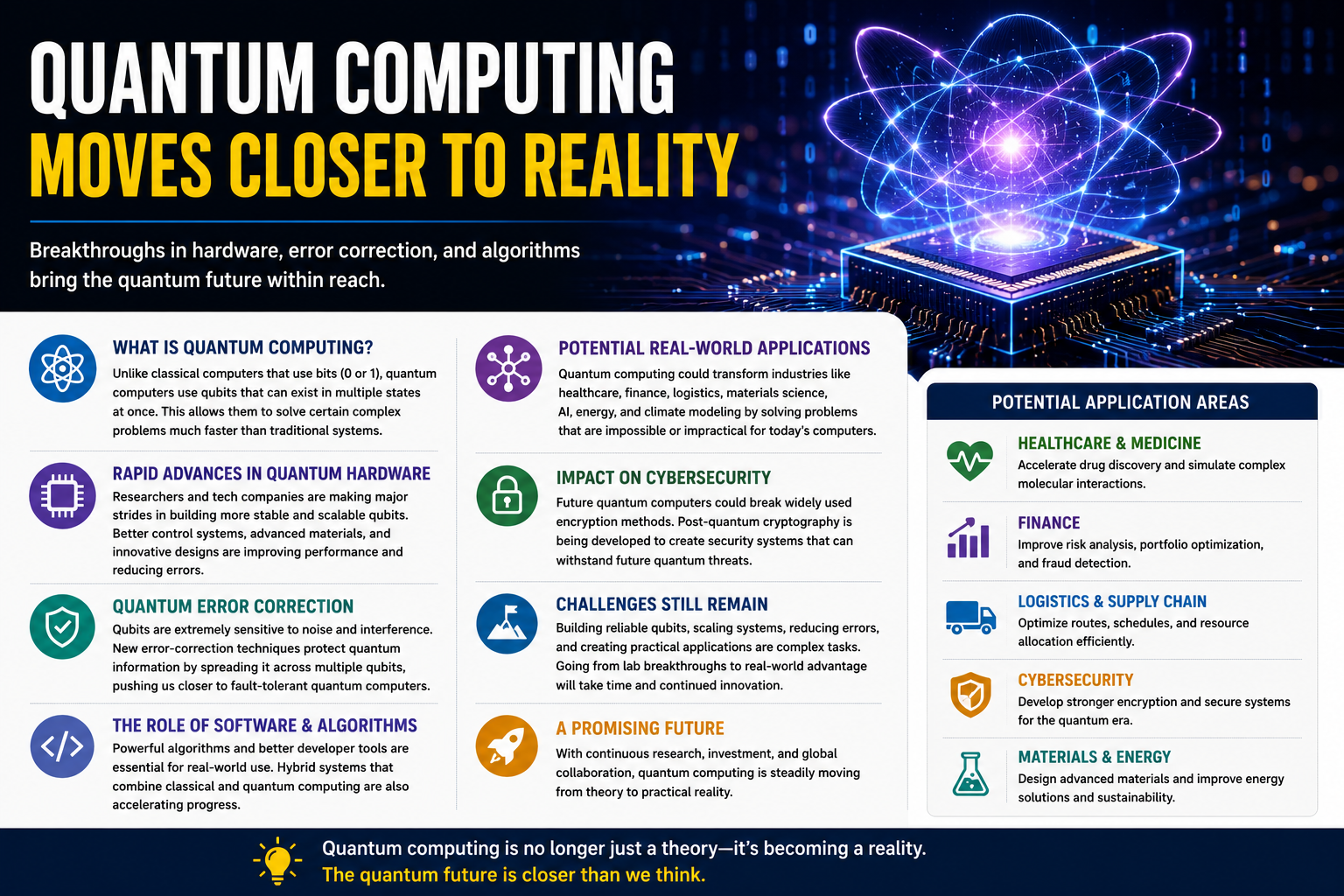
Traditional computers process information using bits that represent either 0 or 1. Quantum computers use quantum bits, commonly known as qubits, which can take advantage of quantum mechanical properties to process certain types of information in fundamentally different ways.
This approach could allow quantum systems to solve particular problems that are extremely difficult for conventional computers. However, quantum computers are not designed to replace ordinary computers for every task. Their potential lies mainly in specialized and highly complex calculations.
One of the biggest challenges in quantum computing is building reliable hardware. Qubits are extremely sensitive to environmental disturbances, which can cause errors and disrupt calculations.
Researchers and technology companies are working on different approaches to create more stable and scalable quantum systems. Improvements in qubit quality, control systems, cooling technologies, and error correction are helping researchers address some of the major technical challenges.
As these improvements continue, quantum processors are gradually becoming more capable and reliable.
Error correction is one of the most important areas of quantum research. Unlike conventional computer bits, qubits can be highly sensitive to noise and interference.
Quantum error-correction techniques aim to protect useful information from these errors by distributing quantum information across multiple physical qubits. Developing efficient error correction could be a major step toward building fault-tolerant quantum computers capable of performing long and complex calculations.
Quantum computing could eventually have applications across many industries. In medicine and pharmaceutical research, quantum systems may help researchers study molecular interactions and explore new drug candidates.
In finance, quantum algorithms could potentially assist with complex optimization and risk-analysis problems. Logistics companies may also benefit from advanced optimization techniques for routes, schedules, and supply chains.
Other potential areas include materials science, artificial intelligence, cybersecurity, energy research, and climate modeling.
Quantum computing is also creating new challenges for digital security. Some powerful future quantum computers could potentially break widely used public-key cryptographic systems.
As a result, researchers and organizations are working on post-quantum cryptography, which aims to develop encryption methods designed to remain secure against future quantum attacks.
The transition to quantum-resistant security is expected to be an important part of preparing digital infrastructure for the quantum era.
Hardware alone will not determine the future of quantum computing. Software, algorithms, and developer tools are equally important.
Researchers are developing quantum algorithms designed to take advantage of quantum processors while working to make programming more accessible. Hybrid systems that combine classical computers with quantum processors may also play an important role as the technology develops.
Despite rapid progress, quantum computing faces significant challenges. Building large numbers of reliable qubits, reducing errors, improving scalability, and developing useful algorithms remain difficult tasks.
There is also a difference between demonstrating that a quantum processor can perform a specialized task and achieving a practical advantage for real-world businesses. Researchers therefore continue to focus on proving useful applications rather than simply increasing the number of qubits.
Quantum computing is still in an early stage, but continued investment and research are accelerating progress. Improvements in hardware, error correction, software, and algorithms could gradually move quantum computers from laboratories into practical applications.
Quantum computing is moving closer to reality as researchers make progress in building more reliable quantum systems and developing useful applications. Although major technical challenges remain, the technology could eventually influence medicine, finance, cybersecurity, materials science, artificial intelligence, and other important fields. The coming years will be crucial in determining how quickly quantum computing can transition from experimental research to practical technology.